
Lab-to-Market Gap (Valley of Death)
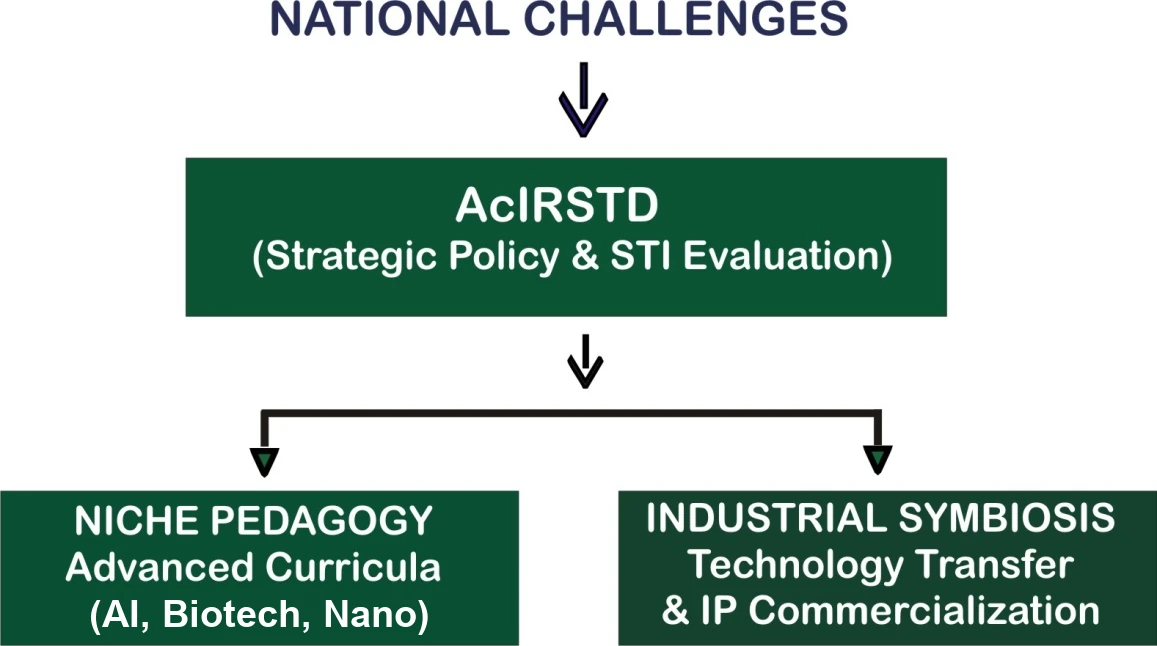
The Academy of Innovative Research, Science & Technological Development (AcIRSTD) operates a detailed framework specifically engineered to bridge the "lab-to-market" (Valley of Death) gap. Recognizing that traditional academic publications often stall at the laboratory phase, AcIRSTD's entire strategy revolves around structured technology transfer, intellectual property (IP) enforcement, and public-private industry agreements.
Through its dedicated Technology Transfer Office (TTO) and Advisory Mechanisms, the Academy handles the complex operational and administrative pipeline needed to move an innovation from a scientific breakthrough to a commercial product.
DETAILED OPERATIONAL PILLARS OF THE LAB-TO-MARKET MODEL
1. Intellectual Property & Demand-Driven Management
Rather than waiting for a researcher to patent a finished idea and hunt for a buyer, AcIRSTD manages the commercial pipeline concurrently with the research.
- IP Advisory Services: The academy provides in-house legal and scientific experts to guide researchers through patent management, filing, and legal structuring.
- Demand and Supply Monitoring: The TTO actively monitors and analyzes the technological needs of industries against what is being developed in laboratories, systematically matching supply with actual corporate demand.
2. Specialized Legal & Commercial Agreements
AcIRSTD designs the transactional framework that traditional universities frequently lack, minimizing bureaucratic delays for corporate buyers.
- Public and Private Sector Agreements: The academy directly administers and generates legal agreements for technical assistance, research and development (R&D), and technology transfers.
- Confidentiality Protections: They establish early-stage non-disclosure and confidentiality frameworks, protecting scientific integrity while allowing corporate stakeholders to inspect prototypes.
3. Industrial Placement and Human Capital Exchange
The academy treats talent mobility as a primary vector for commercialization.
- Enterprise Research Fellowships: They embed academic researchers directly into private enterprises. This gives scientists firsthand operational knowledge of industry constraints while helping companies deploy complex scientific solutions in real-time.
- Dissemination to SMEs: They run dedicated programs designed to push advanced scientific tools into Small and Medium Enterprises (SMEs), which typically lack the capital for their own dedicated R&D departments.
4. Thematic Technology Integration
AcIRSTD focuses its lab-to-market initiatives on sectors requiring heavy infrastructure, deploying solutions across major fields:
- Life Sciences & Biotech: Human health, pharmaceutical applications, and animal/plant food production.
- Advanced Engineering & Materials: Nanotechnology, nanomaterials, clean energy, and bio-fuels.
- Digital Systems: Industrial equipment, communications architecture, and specialized software systems.
Operational Breakdown of the Commercialization Pipeline
| Phase | Academic Action | AcIRSTD Interventions & Supports |
|---|---|---|
| 1. Validation | Prototype testing and laboratory scaling | Assessing technological supply versus industrial market demand |
| 2. Protection | Documenting proprietary processes. | IP management, technological audits and framework setup |
| 3. Integration | Adapting the lab tech to real-world industrial environments | Structuring technical assistance and private sector R&D agreements |
| 4. Deployment |
| |
Executive Summary
Moving Beyond Philanthropy
- Traditional corporate-academic partnerships are built on a philanthropic model—companies donate funds to university departments, and the return is a logo on a brochure or a theoretical thesis that sits on a shelf.
- Value-Driven R&D Alliance: By partnering with AcIRSTD, our partner gains direct access to an agile, cross-border innovation foundry that transforms raw scientific discovery into proprietary commercial assets, de-risks green technology integration, and optimizes industrial supply chains.
Shared Value Matrix (What We Jointly Solve)
Instead of generalized academic research, this partnership targets specific, high-priority industrial bottlenecks:
| INDUSTRY PARTNER NEED | AcIRSTD INTERVENTION |
|---|---|
| High costs of carbon compliance | Circular bio-economy modeling |
| Workforce lacks modern tech skills | Customized agile micro-credentials |
| Slow internal R&D cycles | Shared IP & rapid lab prototyping |
Core Partnership Pillars & Deliverables
Pillar A: Co-Developed Venture Pilots (The Lab-to-Market Pipeline) - AcIRSTD will embed its Fellow Academy Researchers, Scientists and Technologists (FARST) directly into the partner's engineering challenges. Together, we will co-develop and prototype sustainable green technologies - smart resource monitoring, and local alternative biomaterials, granting our partner first-right-of-refusal for commercial licensing.
Pillar B: Corporate Upskilling & Tech-Immersion - AcIRSTD will design custom, rapid-delivery training modules specifically for our partner's engineering and operational teams. These modules cover urgent fields missing from traditional universities, such as Industrial AI, Green Energy Infrastructures, and Nanomaterial Lifecycle Audits.
Pillar C: Certified Research Project Management - AcIRSTD will assign certified professionals (CRP designates) to manage the partner's corporate sustainability projects, ensuring rigorous, scientific evaluation combined with strict corporate timelines, budgetary adherence, and measurable KPIs.
AcIRSTD Sector-Specific Intervention Matrix
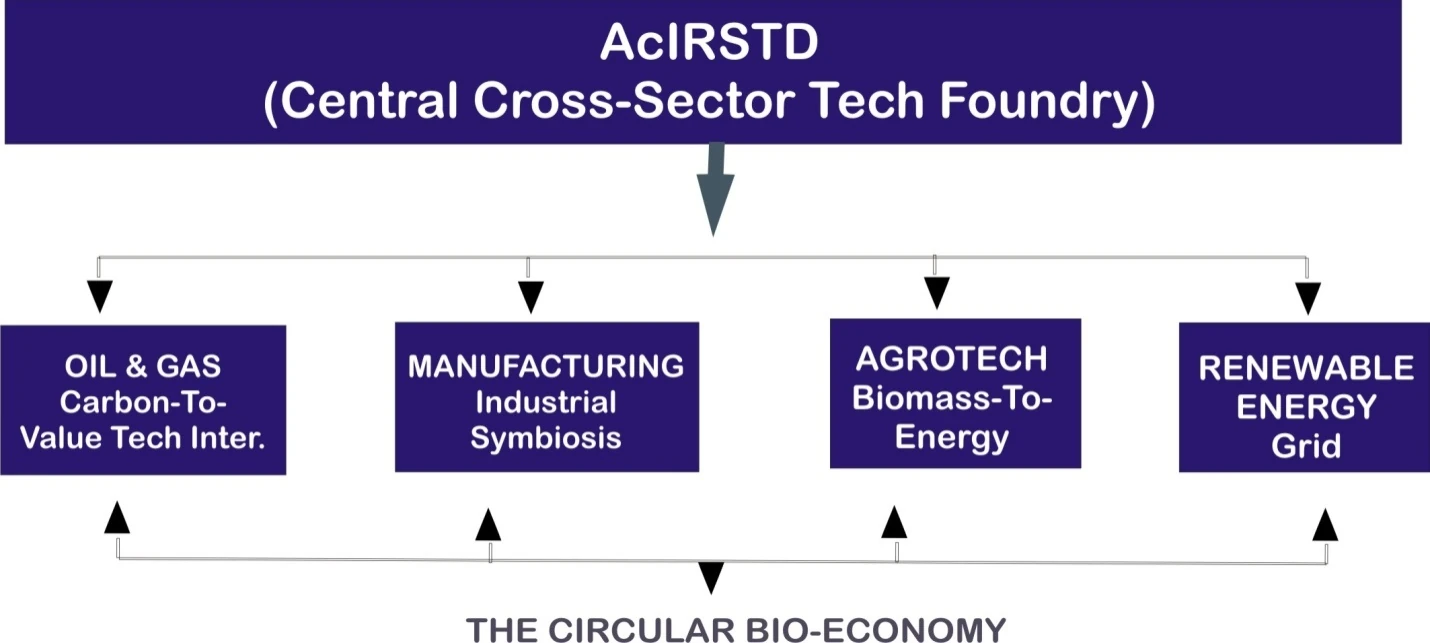
Our collaborative R&D framework targets immediate, high-value industrial solutions across your primary verticals:
a. Oil & Gas (Decarbonisation & Asset Optimization)
- The Industry Bottleneck: Punitive carbon taxes, methane emissions tracking, and the massive financial liabilities of legacy oilfield remediation.
- AcIRSTD Applied Intervention: Co-developing Carbon-to-Value (C2V) systems that capture carbon emissions at source and convert them into industrial-grade polymers. We deploy edge-AI sensor networks for real-time, predictive pipeline leak detection.
b. Manufacturing (Industrial Symbiosis & Material Substitution)
- The Industry Bottleneck: Volatile raw material supply chains, strict municipal waste disposal regulations, and high energy costs.
- AcIRSTD Applied Intervention: Re-engineering factory floor workflows through Industrial Symbiosis. We map your waste streams to serve as raw inputs for alternative building or packaging products, completely bypassing standard disposal costs.
c. Agrotech (Precision Systems & Biomass Utilization)
- The Industry Bottleneck: Post-harvest losses, climate-unpredictable crop yields, and fertilizer dependencies.
- AcIRSTD Applied Intervention: Designing automated, solar-powered precision agricultural systems using localized IoT sensors. We run active pilots converting agricultural crop waste into high-density bio-coal and organic fertilizers.
d. Renewable Energy (Grid Integration & Storage Tech)
- The Industry Bottleneck: Grid instability from solar/wind intermittency and short lifecycles of standard lithium-ion setups.
- AcIRSTD Applied Intervention: Developing robust, localized solid-state and flow-battery storage prototypes optimized for tropical climates. We write predictive machine learning algorithms to balance decentralized mini-grids smoothly.